The Tariff Meant to Help U.S. Drugmakers Is Hitting Them, Too

A 100% tariff on imported brand-name drugs may appear to benefit American drugmakers. On September 29th, the Section 232 tariff was extended to all drugmakers, following its initial application to 17 large companies in July. However, the headline rate differs significantly from the actual economic impact, and the cost distribution is unexpected.
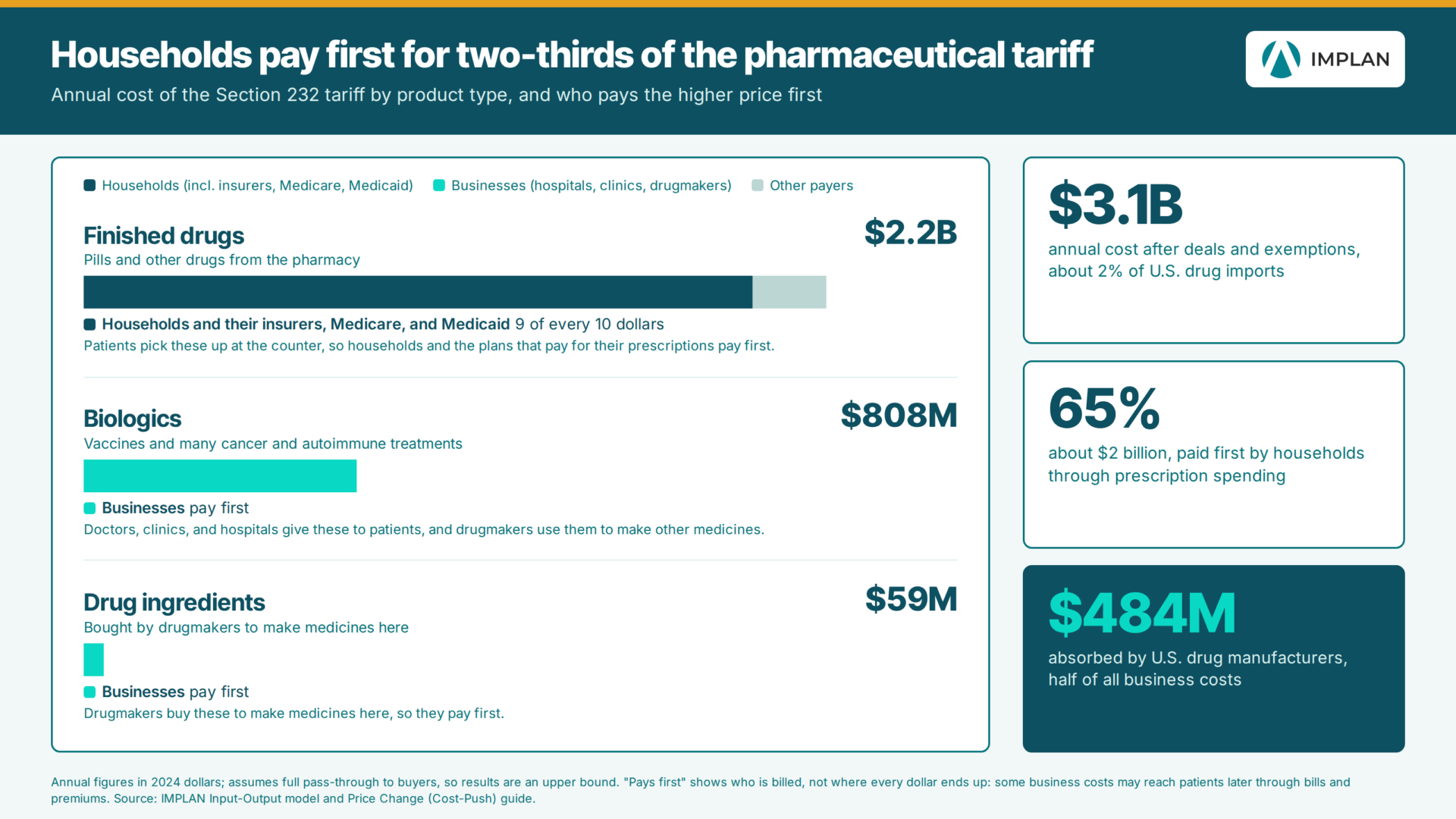
After accounting for deals and exemptions, IMPLAN estimates the tariff’s actual cost at approximately $3.1 billion annually, with American households bearing the majority of this burden. Approximately $2 billion is spent by households on prescription drugs, including payments made by insurers, Medicare, and Medicaid. An additional $1 billion affects U.S. businesses, with half of this amount impacting the American drug manufacturers the tariff was intended to support.
IMPLAN’s economic impact modeling was used to trace the flow of funds resulting from the tariff. The following findings summarize the analysis
The 100% Headline Is Not the Real Number
Exemptions significantly reduce the scope of the tariff. Twenty-six companies, representing approximately 89% of the brand-name market, have signed “Most Favored Nation” pricing agreements that exempt them until early 2029. Generic drugs are largely exempt pending a separate review, and orphan drugs, cell and gene therapies, and other specialty drugs are also generally exempt when produced in one of 19 approved countries, excluding China.
The country of origin also determines the applicable tariff rate. Patented drugs from the European Union, Switzerland, Japan, South Korea, and Liechtenstein are subject to a 15% tariff, while the United Kingdom is exempt under its agreement with the United States. Companies with approved plans to establish U.S. production facilities pay a 20% rate. Drugs imported from India, China, Singapore, and most other countries are subject to the full 100% tariff.
Collectively, these regulations result in a limited portion of imports being subject to the tariff. Of the approximately $146 billion in U.S. drug imports, roughly $10 billion consists of patented drugs that are not covered by pricing agreements or exemptions. The tariff on this segment, primarily at 15% and partially at the full 100%, amounts to approximately $3.1 billion annually, representing about 2% of total drug imports.
Mid-sized and smaller drugmakers without White House agreements are primarily responsible for the remaining tariff burden. These companies are subject to the full tariff, and experts caution that many may respond by increasing prices, merging with larger competitors, or withdrawing products from the market.
Households Pay First for Two-Thirds of it
$3.1 billion is significantly less than the 100% headline rate would imply, but this cost is concentrated among a limited range of drugs and the individuals who depend on them. Approximately $2 billion, or 65%, is initially paid by households through prescription drug expenditures, including payments made by insurers, Medicare, and Medicaid on their behalf.
The initial payer varies by drug type. Pills and other pharmacy-dispensed drugs account for $2.2 billion of the total, with households and their insurance plans paying first due to direct purchase at the pharmacy counter. Approximately 90% of this cost is borne by these groups. Biologics, including vaccines and treatments for cancer and autoimmune diseases, contribute $808 million. These are administered by healthcare providers or used by U.S. drugmakers to produce other medicines, resulting in businesses paying first. Drug ingredients account for $59 million, with drugmakers incurring this cost when purchasing ingredients for domestic production.
It is important to note that these figures indicate the initial payer of the increased costs, not the ultimate distribution of expenses. When hospitals or drugmakers incur higher costs, a portion may eventually be passed on to patients through higher bills or insurance premiums.
Drugmakers Carry Half of the Business Bill
About $1 billion of the cost hits U.S. businesses, and half of that falls on the American drug manufacturers the tariff was meant to help. They incur $484 million in costs annually because they rely on imported biologics and ingredients to manufacture medicines here. Biologics are especially hard to replace: U.S. buyers import about 96% of the biologic medicines they use, leaving little domestic supply to switch to when prices rise.
Hospitals and physicians’ offices are also affected. Hospitals absorb approximately $47 million annually, while physicians’ offices incur about $32 million in costs, primarily through finished drugs and medicinal ingredients.
Working Families Feel It Most
Prescription drug expenditures constitute a larger proportion of the budget for lower- and middle-income households, resulting in a greater tariff burden per dollar spent. Households with incomes between $50,000 and $70,000 incur approximately $1.65 in tariff costs per $10,000 spent, which is 2.5 times the burden faced by households earning more than $200,000. For households earning between $15,000 and $70,000, the cost ranges from $1.31 to $1.65 per $10,000, approximately double that of the highest income bracket.
The Bigger Bill Could Come in 2029
Current costs remain modest because most brand-name drugs are still protected by exemptions. These pricing agreements expire in early 2029, and if the exemptions are not renewed, a significantly larger proportion of brand-name drugs would become subject to tariffs, potentially substantially increasing household costs.
Domestic drug production also becomes more costly initially. Establishing U.S. manufacturing capacity requires several years, and during this period, the tariff increases expenses for existing domestic manufacturers. Companies with approved U.S. production plans currently pay a 20% tariff, which will increase to 100% in April 2030.
Aggregate figures may obscure significant price increases for certain drugs. Patients dependent on non-exempt medicines from smaller manufacturers could experience a doubling of prices or the withdrawal of these drugs from the U.S. market.
How We Modeled It
IMPLAN’s Input-Output model and Price Change (Cost-Push) Guide were utilized to trace how a price increase for a single product is distributed among businesses and households. The tariff was modeled for the United States as a whole using 2024 data. Imports in each product group were limited to patented drugs not covered by pricing agreements or exemptions, and these were weighted by each country’s tariff rate, resulting in an effective rate of approximately 2% on imports. Finished drugs and drug ingredients were modeled as price increases, while biologics, which are almost entirely imported, were allocated to buyers based on total purchases. Household burden was measured by dividing each income group’s share of the tariff cost by its total household spending.
All annual figures are presented in 2024 dollars and assume complete pass-through of costs to buyers, representing an upper-bound estimate. The term “households” includes payments made by insurers, Medicare, and Medicaid for household prescriptions, and therefore does not equate to out-of-pocket expenses.
What to Watch Next
Three signals will show how large this cost becomes: whether mid-sized and smaller drugmakers without pricing agreements raise prices or pull products, whether the exemptions tied to those agreements hold as early 2029 approaches, and how U.S. manufacturers fare when the 20% rate for companies with approved production plans rises to 100% in April 2030. Tariffs move through supply chains into hospitals, pharmacies, and household budgets, and IMPLAN’s Forward Linkages Suite traces that path from the price change to the buyers who absorb it. Request a demo to model how a tariff or price change would affect your region or industry, or explore the Forward Linkages Suite.