
| Effect | Employment | Labor Income | Output |
|---|---|---|---|
| Direct | 606.57 | $131,343,642 | $500,000,000 |
| Indirect | 359.12 | $38,713,113 | $100,175,173 |
| Induced | 349.26 | $26,045,726 | $76,682,854 |
| Total | 1,314.95 | $196,102,481 | $676,858,028 |
What is a Multi-Regional Input-Output (MRIO) Analysis?
Every impact study draws a boundary somewhere. MRIO tracks what happens when the economic activity you’re measuring doesn’t stop at that line, so spending that crosses a border shows up as impact not as loss.

MRIO:
A Multi-Regional Input-Output (MRIO) analysis measures how an economic event in one region, a new facility, a stimulus program, a university expansion, affects every other region connected to it through trade and commuting. Instead of treating spending that crosses a study-area boundary as “leakage,” MRIO tracks where that spending goes and what it generates when it gets there.
The Problem MRIO Solves
Every economic impact study has to define a study area: a county, a metro, a state. But real economic activity doesn’t respect that boundary. A supplier two counties over. A worker who commutes across a state line. A distributor three states away. Traditionally, all of that spending gets treated as “leakage,” money that leaves your study area and simply disappears from your results.
That’s not because it stops mattering. It’s because a single-region model has nowhere to put it.
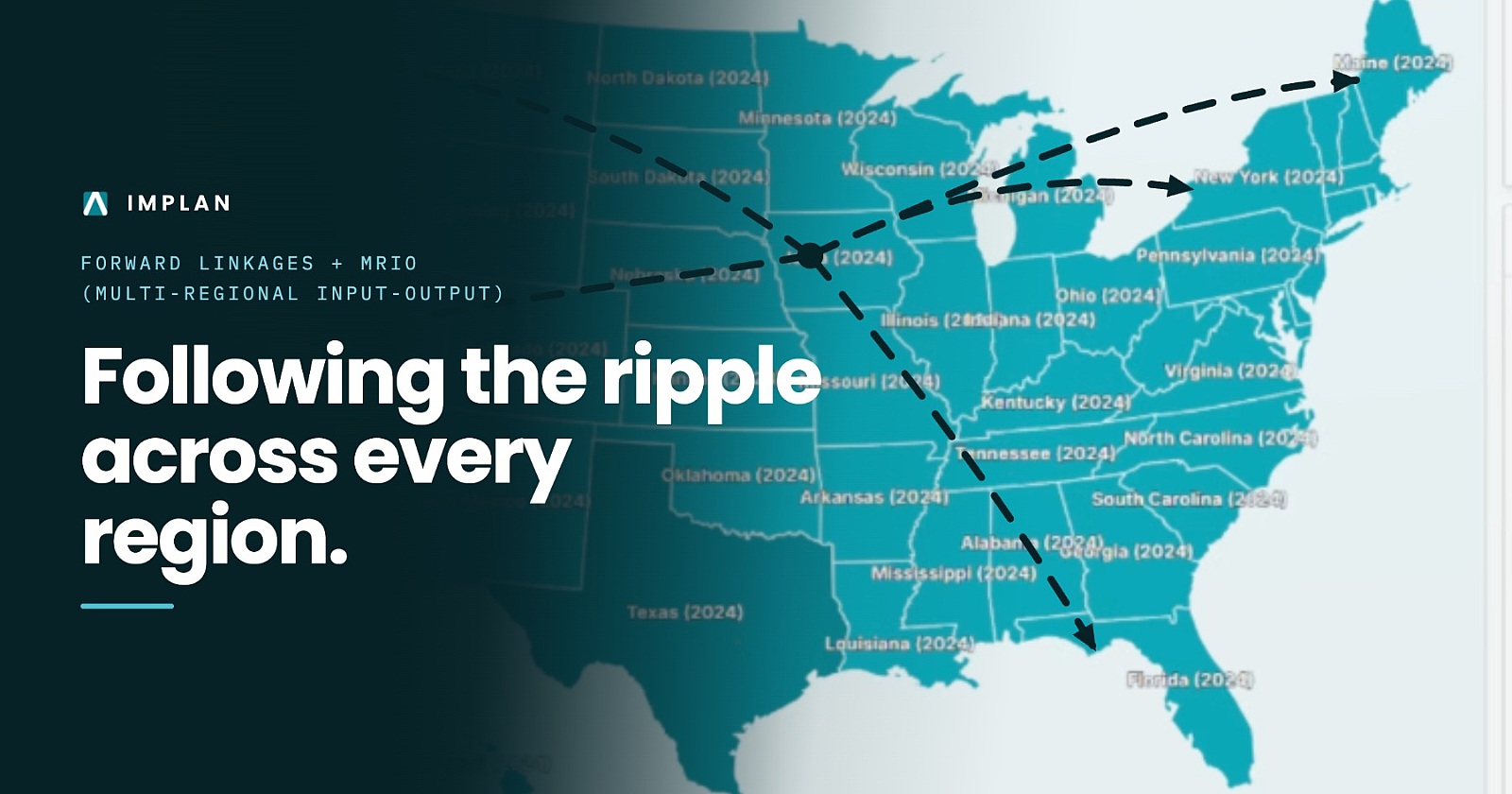
The effect isn’t limited to nearby spillover, either. It can travel much farther through supply chains. A steel tariff meant to protect producers in one state can raise costs for automakers, appliance makers, and construction firms hundreds of miles away. Effects like that, sometimes called forward linkages, only show up clearly when your model can see past a single region.
MRIO gives that activity somewhere to go.

Included in All IMPLAN Subscriptions
MRIO isn’t a separate product or a paid add-on. It’s available with any IMPLAN subscription that includes access to multiple regions; if you can already select more than one region in your account, you can build an MRIO event today. No upgrade, no new license, no extra step.
How MRIO Works: A Real Example
Say a bank opens a $500 million headquarters in Mecklenburg County, NC. Right across the state line sits York County, SC linked to Mecklenburg by trade and by workers who commute between the two. Here’s what an MRIO analysis of that HQ shows and what it catches that a single-region model never would.
Combined Multi-Regional Result:
Filtered to Mecklenburg County, NC (where the HQ actually is):
| Effect | Employment | Labor income | Output |
|---|---|---|---|
| Direct | 606.57 | $131,343,642 | $500,000,000 |
| Indirect | 355.33 | $38,381,598 | $99,117,169 |
| Induced | 316.21 | $24,348,847 | $70,345,227 |
| Total | 1,278.11 | $194,074,088 | $669,462,396 |
Filtered to York County, SC (no facility here at all):
| Effect | Employment | Labor income | Output |
|---|---|---|---|
| Direct | 0 | $0 | $0 |
| Indirect | 3.79 | $331,515 | $1,058,004 |
| Induced | 33.05 | $1,696,878 | $6,337,628 |
| Total | 36.84 | $2,028,393 | $7,395,632 |
That York County table is the real story. There’s no Direct row at all: no facility, no HQ jobs. But 3.79 jobs and $331,515 in labor income show up from supply-chain purchases (the indirect effect), and another 33.05 jobs and $1,696,878 show up from household spending by workers connected to the Mecklenburg HQ (the induced effect). Add the two together and York County gets 36.84 real jobs and just over $2 million in labor income, activity that exists only because of a bank headquarters sitting in a different state.
What a single-region model would have missed
Model Mecklenburg County alone (the way a traditional single-region analysis works) and the numbers stop at 1,278.11 jobs and $669.5M in output. MRIO adds York County back in: another 36.84 jobs, $2 million in labor income, $7.4 million in output. Add Mecklenburg’s totals to York’s and they reconcile exactly with the combined multi-regional result above: 1,278.11 + 36.84 = 1,314.95 jobs, $194,074,088 + $2,028,393 = $196,102,481 in labor income. Nothing is estimated or lost; every dollar and every job is accounted for in whichever region it actually landed in. A single-region view just never shows you the York County rows at all.
Want the full breakdown, including how to set this up step by step? Read MRIO: Introduction to Multi-Regional Input-Output Analysis.
When To Use MRIO vs. Single-Region Input-Output
There are really three ways to approach a study area, not two:
| Small, precise region | Large, complete region | MRIO | |
|---|---|---|---|
| Spending that leaves the study area | Counted as "leakage" and lost to the model | Mostly captured, since more activity now falls inside the (bigger) boundary | Tracked to the exact linked region it actually lands in |
| How well it represents the area you care about | Very precisely, but incompletely | Blurred: a big region is a weighted average of everything inside it | Both at once: the precise region for direct impact, plus real ripple effects across linked regions |
| Best suited for | A self-contained local economy with minimal cross-border activity | A rough, big-picture estimate where precision doesn't matter | Real activity that crosses lines — multi-state projects, commuting zones, regional supply chains |
Who Uses MRIO?
- Economic development organizations
- Universities
- Research institutions
- Government agencies
- Consultants
- Multi-region firms
- Multi-location businesses
- Economic development organizations
- Universities
- Research institutions
- Government agencies
- Consultants
- Multi-region firms
- Multi-location businesses
- Economic development organizations
- Universities
- Research institutions
- Government agencies
- Consultants
- Multi-region firms
- Multi-location businesses
- Economic development organizations
- Universities
- Research institutions
- Government agencies
- Consultants
- Multi-region firms
- Multi-location businesses
- Economic development organizations
- Universities
- Research institutions
- Government agencies
- Consultants
- Multi-region firms
- Multi-location businesses
- Economic development organizations
- Universities
- Research institutions
- Government agencies
- Consultants
- Multi-region firms
- Multi-location businesses
- Economic development organizations
- Universities
- Research institutions
- Government agencies
- Consultants
- Multi-region firms
- Multi-location businesses
- Economic development organizations
- Universities
- Research institutions
- Government agencies
- Consultants
- Multi-region firms
- Multi-location businesses
- Economic development organizations
- Universities
- Research institutions
- Government agencies
- Consultants
- Multi-region firms
- Multi-location businesses
- Economic development organizations
- Universities
- Research institutions
- Government agencies
- Consultants
- Multi-region firms
- Multi-location businesses
MRIO: Frequently Asked Questions
It’s an economic impact model that tracks how activity in one region affects every other region it’s economically connected to through trade and commuting, rather than stopping at a single study-area boundary.
No. MRIO is available with any IMPLAN subscription that includes access to multiple regions — there’s no separate license or paid add-on. If your account can already select more than one region, you can build an MRIO event today.
A standard (single-region) analysis treats any spending that leaves the study area as lost. MRIO instead follows that spending into the linked region and models what it generates there, giving a fuller picture of total impact.
Leakage is spending that crosses your study area’s boundary. In a single-region model it’s simply subtracted from the total; in an MRIO model, that same spending is tracked to where it actually lands and counted as real impact there.
Direct effects are the immediate activity from the event itself. Indirect effects ripple through the supply chain. Induced effects come from household spending of wages earned from the direct and indirect activity, and in an MRIO model, all three can occur across more than one region.
As many as the study requires — from two adjacent counties up to complex, large-scale, nationwide breakdowns. Very large builds (100+ regions, Congressional Districts, statewide Combined Regions) use IMPLAN’s Large-Scale MRIO capability, which requires a quick access request through your CSM rather than being on by default.
Whenever the activity you’re measuring plausibly crosses a jurisdictional line — a multi-state project, a facility drawing workers from neighboring counties, or a supply chain that isn’t contained within your study area. IMPLAN’s own guidance: if you want to report state-wide ripple effects from activity in specific counties, MRIO is the better choice over a state-level model.
Aggregation bias happens when a region is drawn so broadly that it becomes a weighted average of everything inside it a statewide number for an industry can look nothing like the real figure in any single county that makes it up. MRIO lets you define regions more precisely, so those real differences stay visible instead of getting averaged away.
Yes. If, say, a company opens a headquarters in one county and a smaller satellite office in a neighboring state, MRIO can model both as separate direct impacts within the same analysis, while still capturing how they affect each other through trade and commuting.
Not exactly: MRIO results are slightly non-linear. A project five times larger won’t produce results exactly five times as large, because bigger flows take more modeling cycles to fall below the threshold IMPLAN uses to stop tracking inter-regional trade. In practice, this means results scale a little more than proportionally as a project grows.
Forward linkages trace an industry’s output downstream, to what buys and uses it, rather than backward to its suppliers. It’s a related, separate capability (IMPLAN’s Forward Linkage Suite) that MRIO extends across regions, so downstream effects like a tariff or price change can be traced beyond a single area.
Learn More About MRIO:


See What MRIO Shows You That a Single Region Can't
It’s already part of your subscription; if you have access to more than one region, you’re ready to build your first MRIO analysis today.