IMPLAN Case Study
Great Buildings, Great Places: The Economic Benefits of an NMTC-Funded Development Effort

Introduction:
Low income communities across the country struggle every year to gain economic footholds. Likewise, economic development groups struggle to devise strategies by which they can provide aid to these areas. In many of these communities the poverty rates, unemployment rates, and median family incomes are disproportionately high or low (respectively) compared to national averages.
One of the largest obstacles hindering economic progress in these communities is the scarcity of available capital; there simply isn’t enough money in these areas to fund projects or increased production efforts which might stimulate economic development. For this reason, projects of this nature depend largely upon private investment dollars in order to be realized. Simultaneously, the incentives for private investors to finance efforts in these areas are, unfortunately (but understandably) scant. For this reason, disadvantaged areas often find themselves in seemingly inescapable cycles of economic deprivation; the community’s economy remains subject to decline because nobody will invest in improving it, and nobody will invest in improvement the community because its economy is lagging.
However, in 2000, Congress passed an initiative called the New Markets Tax Credits (NMTC) program with the goal of combating this very issue and stimulating private investment in businesses located in nationally recognized areas of need.
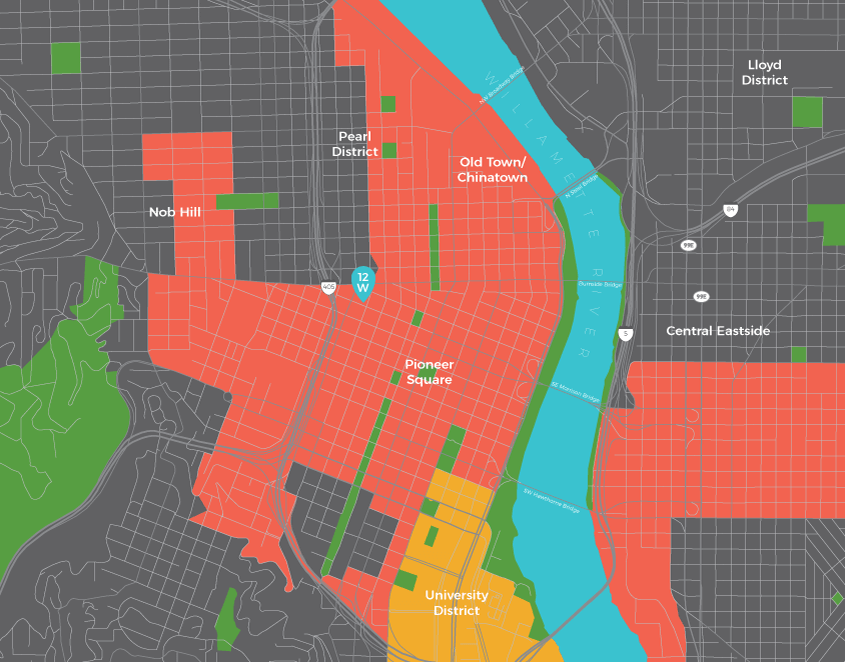
A real-world example of the collective efforts of this process bringing about change in an economically underserved community is the “12W” project. Named after the location of the resulting structure (SW 12th & Washington Avenues), the 12W project saw the development of a brand new mixed-use commercial office, retail, and residential facility in a recognized census tract west of Portland, Oregon’s central downtown district. Overseen by the United Fund Advisors (UFA), a CDE that invests in numerous development projects each year, the effort aimed to create 274 units of new affordably priced rental housing, provide 85,000 square feet of new office space, and to connect Portland’s Pearl District with the Central Business District.
The NMTC program is a federally-based tax initiative, much like the many active housing tax credit programs across the country, meant to serve the public by spurring private equity investment, providing jobs, and stimulating local spending. Unlike housing tax credits however, New Markets Tax Credits are far more flexible in that their allocated funds can be used for a wider assortment of development projects, including healthcare centers, hotels, educational facilities, youth and recreation centers, public infrastructure, and more.
That said, the application process and criteria by which New Markets Tax Credit allocations are determined is quite rigorous. For starters, NMTC allocations are only approved for use in qualified census tracts. Census tracts are defined as geographic areas with changing, but stable, populations ranging from roughly 2,500 to 8,000 people: the approximate size of a neighborhood or locality.
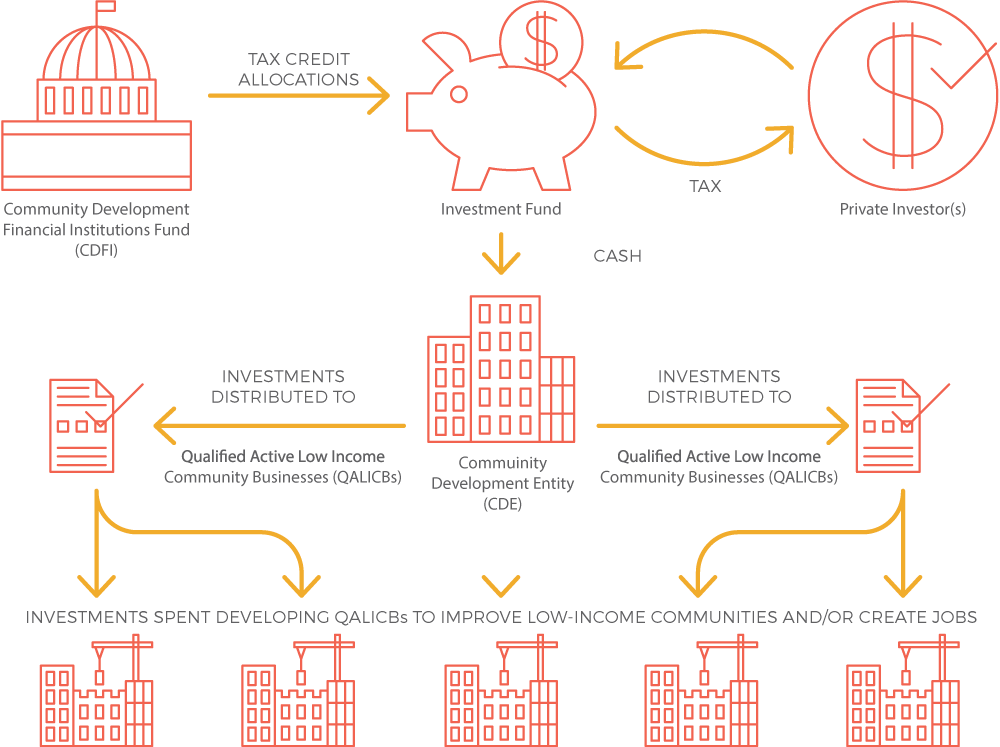
The application process entails intensive reviews and assessments of privately managed Community Development Entities’ (CDE) proposed projects/uses to determine whether or not they qualify for the program’s funds.
Upon acceptance, funds are subsequently allocated to CDEs by the Community Development Financial Institution Fund of the U.S. Treasury. These recipients are able to issue tax credits to private investors in exchange for usable capital interest in furthering the effort outlined in the qualified project.
New Market Tax Credit Program? Here's the Gist...
The Problem:
The 12W project addressed several issues at the heart of Portland’s Pearl District struggles.
Many of the problems spurred by the area’s depressed economic state relate to employment and income. Given the lack of financial investment in the area, employment opportunities were scarce. As a result, the unemployment rate throughout the community was 3.2 times the national average. Furthermore, subsequent household income earnings in the community suffered in response. 50% of its population lived below the poverty line. The average household in the community earned only 40% of the median family income relative to others throughout the state of Oregon.
But, while the increases in local economic spending, short-term jobs, and long-term jobs resulting from the 12W project undoubtedly brought economic benefits to the area, the project’s champions faced an additional challenge: proving it. How could they quantify those benefits? How could they explicitly communicate the economic value of the project? How could they best fortify the CDFI’s confidence in them and guarantee continued allocations for future products?
UFA and its partners needed an effective strategy for putting their organizations’ and projects’ value into hard numbers. Economic impact analysis proved to be that strategy.
The Solution:
Using IMPLAN data proved to be an invaluable choice for UFA and its partners in their search for metrics and data-driven evidence of the value of the 12W project.
In assessing its benefits, UFA were able to quantify the widespread effects of the $29 million allocation they were granted and were able to deliver, on paper, the number of jobs that their use of that spending might create and the dollars of local spending it could stimulate. Furthermore, economic impact analysis is such a thorough method of analysis that their study was actually able to reveal the dollars of indirect and induced economic activity that by the project’s spending could stimulate as well.
This meant that in addition to being able to track how much spending might be stimulated by the project itself amongst local businesses, they were also able to track how much spending might be stimulated by those businesses’ and their employees. In fact, economic impact analysis is so thorough that it’s able to do this until all of the original spending has effectively exited the region, essentially allowing an analyst to track each and every dollar of their original spending along its entire journey through the local economy.
So, by using IMPLAN data to perform economic impact analysis, UFA was able to show the CDFI, down to the dollar, the exact amount that their allocations could stimulate and the industries the project might affect most greatly.

How Does an Economic Impact Study Come Together?
Direct Effects:
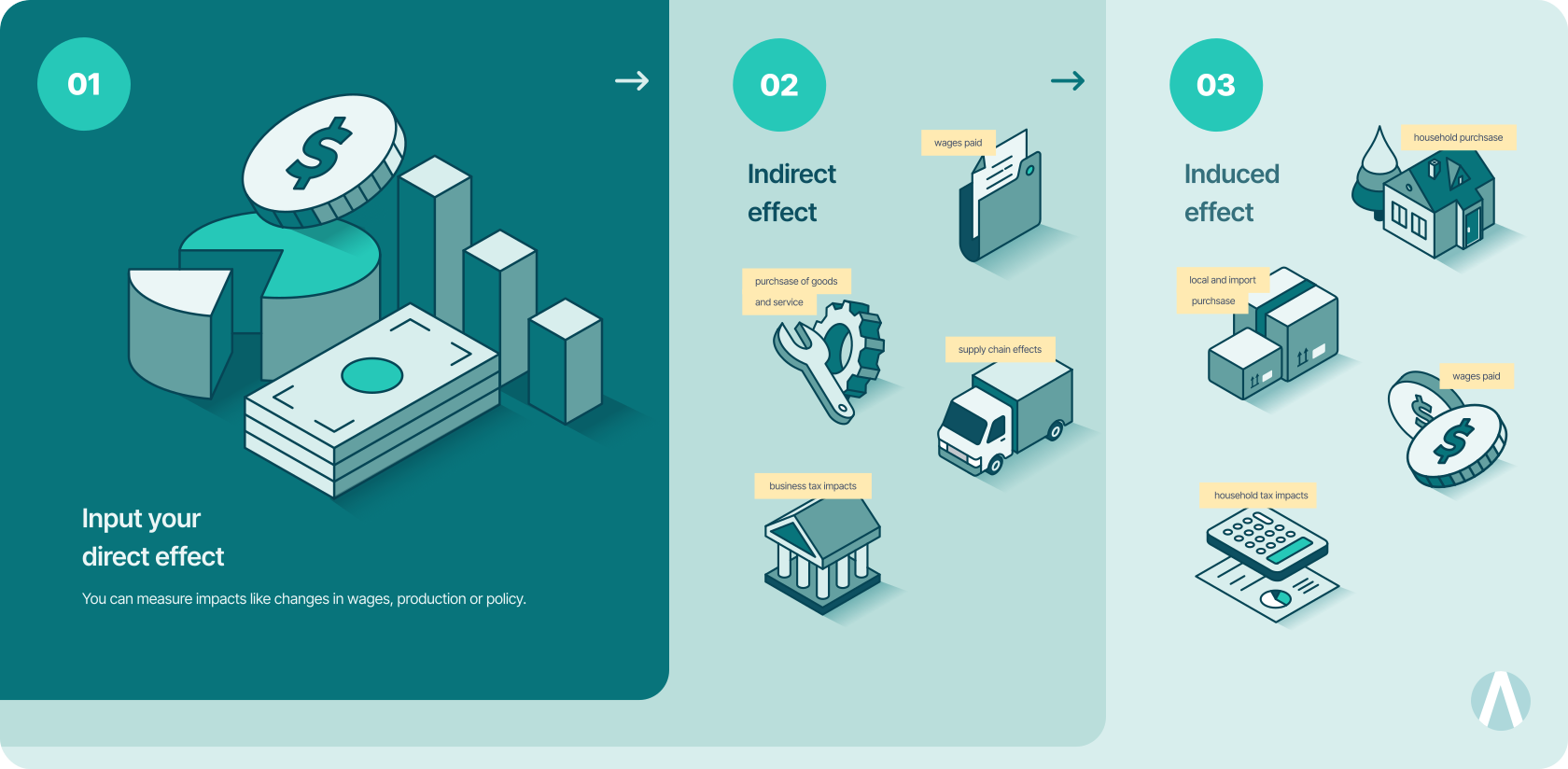
The set of expenditures applied to the predictive model (i.e., I/O multipliers) for impact analysis.
It is a series (or single) of production changes or expenditures made by producers/consumers as a result of an activity or policy. These initial changes are determined by an analyst to be a result of this activity or policy. Applying these initial changes to the multipliers in an IMPLAN model will then display how the region will respond, economically to these initial changes.
Indirect Effects:
The impact of local industries buying goods and services from other local industries. The cycle of spending works its way backward through the supply chain until all money leaks from the local economy. The impacts are calculated by applying Direct Effects to the Type I Multipliers.
Induced Effects:
The response by an economy to an initial change (direct effect) that occurs through re-spending of income received by a component of value added. IMPLAN’s default multiplier assumes that labor income (employee compensation and proprietor income components of value added) is not a leakage from the regional economy. This money is recirculated through the household spending patterns causing further local economic activity.
The Results:
Using IMPLAN data, UFA was able to acquire and present, with unwavering confidence, evidence of the 12W project’s potential benefits.
While UFA recognizes that no single project can turn the fortunes of an entire city around overnight, it holds faith that over time, a stronger focus on investment in communities creates a culture which attracts new ideas and innovation, resulting in large-scale and widespread improvements.
Of this philosophy, Dennis Wilde from Gerding Edlen Development, one of UFA’s many partnering groups in the project, said, “It is more important to build great places than great buildings.”
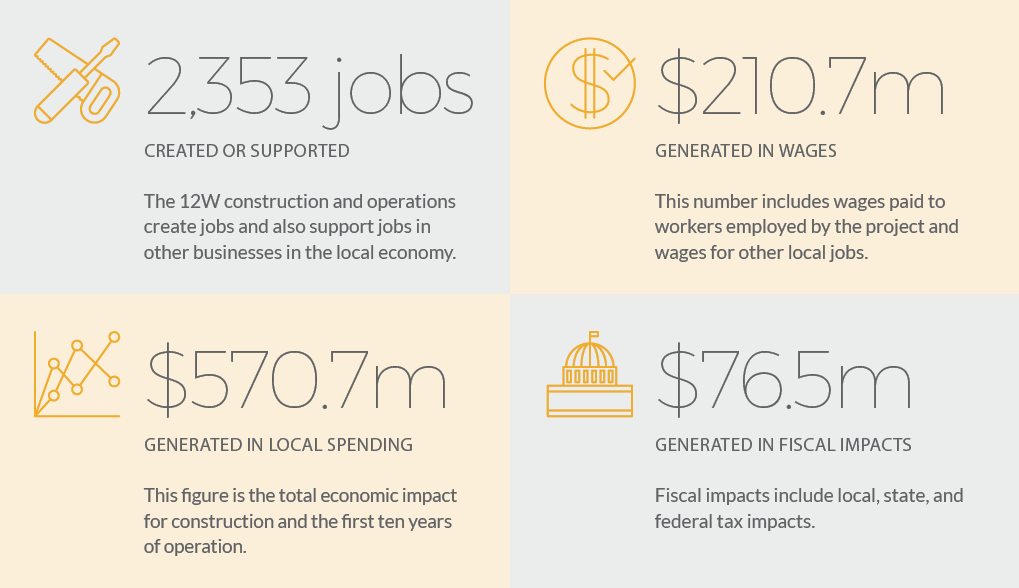
The impact analysis of the project revealed some pretty staggering figures attributable to both the project’s construction phase and including the resulting structure’s first 10 years of operations.
According to Novogradac & Company LLP, between 2007 and 2017, in this recognized census tract the poverty rate decreased from 50% to 28%.
By using impact data from IMPLAN to quantify the economic effects of the 12W project, United Fund Advisors was able to strengthen their portfolio’s track record of success by justifying their use of New Markets Tax Credits allocations. With a stronger standing and a proven history of community-aiding investments, UFA discovered the value of including frequent impact analyses in their regular business strategies with the goal of securing more allocations in years to come.