
IMPLAN Case Study
How QTS Data Centers Uses IMPLAN to Communicate the True Economic Value of Data Center Development

Introduction:
QTS Data Centers is the largest, fastest-growing data center company in North America, and it’s expanding quickly across Europe, with a growing footprint in London. QTS designs, builds, and operates data centers that manage and secure massive amounts of digital information for some of the largest organizations in the world. Its tenants fall into three categories: hyperscale technology companies, Fortune 1000 enterprises, and federal government agencies with strict security requirements.
Every new data center project represents a significant, multi-year capital investment, often unfolding across multiple buildings and construction phases. Before a single foundation is poured, QTS has to earn the confidence of the
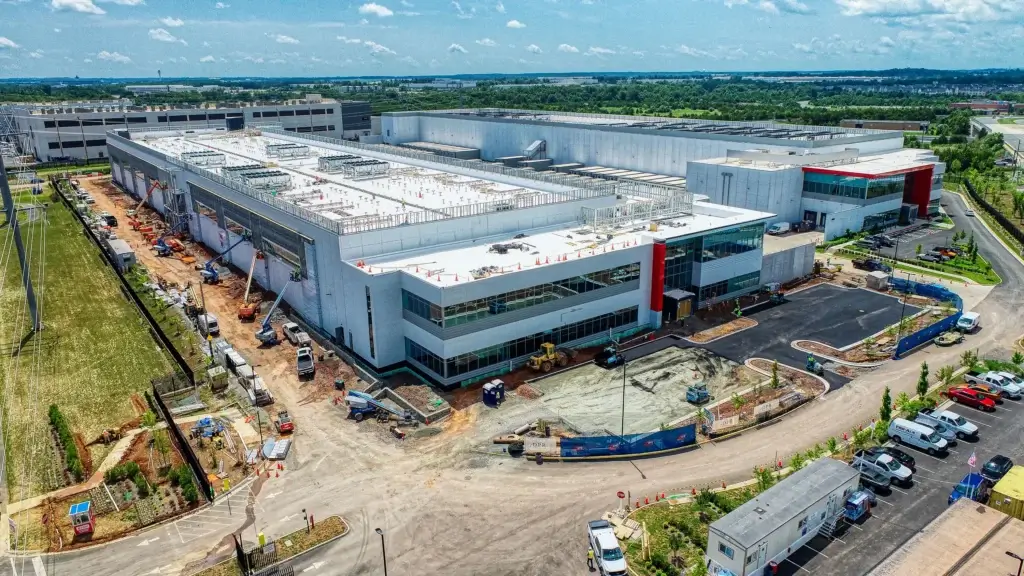
communities where it builds. That means helping mayors, local officials, and other stakeholders understand what a project will really mean for their region, while cutting through common misconceptions about water usage and job creation along the way.
That responsibility sits with Jeff Green, Economic Development Program Manager at QTS. Jeff is typically the first person at QTS to build the economic case for a new project, working directly with local leaders to explain the value a data center will bring to their community before the deal is finalized.
IMPLAN delivers powerful, real-world insights that help us communicate the true economic impact of our projects. Even for complex, multi-year investments like a large-scale data center campus, it gives us the clarity we need to model outcomes over time and support our decision-making.

The Challenge: Making the Case Before Ground Is Broken
Data center projects don’t move in a straight line. In the early stages, almost everything is still in flux: how much power is available, whether the project needs 10 buildings or 3, whether land is still being assembled. Early conversations with a community are often necessarily general: a headline commitment like “we’re going to invest a billion dollars in your community” is enough to open the door, but it isn’t enough to earn lasting trust.
At the same time, Jeff regularly runs into the same misconceptions in new markets. Communities often assume data centers consume enormous amounts of water, or that they create few jobs. In reality, the picture is more nuanced, data centers typically create fewer jobs than some other developments, but the jobs they do create tend to be higher-quality and higher-paying, on top of the substantial construction employment generated during the build. Correcting the narrative requires more than a talking point; it requires credible data.
The Solution: Modeling Real Economic Impact With IMPLAN
Jeff’s familiarity with IMPLAN goes back to his time as a public-sector economic developer, where he worked alongside consultants who used the platform. That experience shaped how he thinks about bringing data-driven economic analysis in-house at QTS.
Today, IMPLAN comes into play in the middle-to-late stages of a project, once the fundamentals, power, land, building count, are settled. As plans solidify, Jeff uses IMPLAN to move the conversation from a general investment pledge to a substantiated, data-backed story about the value a project will bring.
A key part of that value is credibility. IMPLAN’s outputs are widely used, well-regarded, and transparent about where the underlying data comes from, a major reason QTS relies on the platform. Inputs can be adjusted and refined project to project, but the outputs stakeholders see are built on a solid, defensible foundation.
The Process:
Using IMPLAN, Jeff and QTS are able to:
- Move discussions with local leaders beyond a generalized investment pitch into a substantiated economic case as project details solidify
- Model the direct, indirect, and induced effects of a project, rather than relying on a single multiplier that’s hard for non-economists to interpret
- Support public engagement and consultation processes, including a recent effort in the UK
- Reframe common misconceptions about job creation and community benefit with credible, data-backed numbers

One recent example: QTS used IMPLAN to inform a public consultation process in the UK. Rather than presenting stakeholders with multipliers alone, which can be difficult to translate into something meaningful, Jeff built a broader thought framework around the analysis, one that highlighted the secondary and tertiary effects of the project rather than stopping at the immediate, visible impacts. That framing helped stakeholders see past the headline investment number to the fuller economic story underneath it.
The Results: A Realistic Model for Complex, Phased Projects
Data center campuses are uniquely complicated to model. They’re multi-year investments, often built out in phases across many buildings, with impacts that shift and compound as construction and operations unfold. For Jeff, IMPLAN’s core value is its ability to produce realistic outputs for exactly this kind of complexity.
With IMPLAN, QTS is able to:
- Model data center construction and development in stages, reflecting how a project actually unfolds rather than treating it as a single static event
- Account for multiple years of activity as new buildings come online
- Show the true value of a project through direct, indirect, and induced impacts, not just headline figures
- Bring a credible, third-party-grounded model into conversations with mayors, communities, and other stakeholders
Looking Ahead
QTS is still early in scaling its use of IMPLAN. Jeff sees an opportunity to build out a standard, repeatable model that consistently shows the economic growth and tax revenue tied to QTS projects, and hopes to dedicate more internal bandwidth to that effort going forward.
“IMPLAN delivers valuable, real-world insights that help us model and communicate the true economic impact of our projects over time. Even with something as complex as a multi-year, 16-building data center campus, it gives us the ability to reflect how development actually unfolds and tell a realistic, compelling story to our stakeholders.”
Jeff Green, Economic Development Program Manager
QTS Data Centers