Regional Fission How MSU Accelerated Their Research Facility Funding Using MRIO
See how one group of researchers estimated their economic impact and tracked its contribution to their state’s regional economy.

Introduction
What does it take to be the No. 1-ranked nuclear physics graduate program in the country? As it turns out, a whole lot of help and no small measure of serendipity. In June 2008 the Office of Nuclear Physics (NP), Office of Science (SC), and the U.S. Department of Energy (DOE) made an exciting announcement:
“Now receiving pre-applications for developing outstanding scientific opportunities in nuclear structure and dynamics, nuclear astrophysics, and tests of fundamental interactions and symmetries at leading rare isotope beam (RIB) facilities around the world.
The mission of the NP program is to enable fundamental research in nuclear physics that will advance our knowledge of the nature of matter and energy, and develop the needed technologies and workforce. While the U.S. is planning for a national facility for rare isotope beams (FRIB) in the latter part of the next decade, it is crucial for U.S. scientists to maintain leadership in the field. To that end, the Office of Nuclear Physics intends to provide funding for the U.S. nuclear physics research community to play a prominent role in developing outstanding research opportunities in nuclear structure and dynamics, nuclear astrophysics, and tests of fundamental interactions and symmetries at leading RIB facilities currently operating, being upgraded or being constructed around the world. The capabilities at these facilities will provide unique opportunities for U.S. nuclear physics researchers to stay engaged at the forefront of the field, both scientifically and technologically, including opportunities for research collaboration, accelerator research and development activities, and fabrication of accelerator components or scientific instrumentation.
The Office of Nuclear Physics envisions multi-year funding for one or more proposals with relevance for the planned U.S. RIB facility.”
The future facility would offer, for the first time, the capability to produce most of the same rare isotopes that are created in the thermonuclear explosions of supernovae, which then decay into the elements found on Earth. The hopes for a facility with this capability centered on better understanding the origins of the elements. The same isotopes are needed to develop a comprehensive model of atomic nuclei and how they interact. Researchers would be able to improve our understanding of how atomic nuclei may be used to diagnose and cure diseases. Improved nuclear models and precision data would allow optimization of the next generation of nuclear reactors and evaluation of techniques to destroy nuclear waste.
Modeling atomic nuclei and their interactions—a challenging problem in science—can also help lead to breakthroughs in security, the environment, high energy physics, nanoscience, and more. Many time-honored and newly-conceived institutions submitted pre-applications in response to the DOE’s Funding Opportunity Announcement. A handful were invited to submit formal applications later that year for the opportunity to house and manage the facility. But only one could be chosen.
Getting Started
The DOE announced on 11 December 2008 that Michigan State University (MSU) had been selected to design and establish the FRIB.
The new facility was expected to take about a decade to design and build and to cost an estimated $550 million. It would a be hub for providing research opportunities for an international community of approximately 1,000 university and laboratory scientists, postdoctoral associates, and graduate students.
“The Department of Energy’s new Facility for Rare Isotope Beams at Michigan State University promises to vastly expand our understanding of nuclear astrophysics and nuclear structure,” said Acting Associate Director of the Office of Science for Nuclear Physics Eugene Henry. “This capability will allow physicists to study the nuclear reactions that power stars and stellar explosions, explore the structure of the nuclei of atoms and the forces that bind them together, test current theories about the fundamental nature of matter, and play a role in developing new nuclear medicines and techniques.”
And now MSU, as the winning candidate for the program funding, would not only have to meet federal budget standards, but they would also be subject to a cooperative agreement between MSU and the DOE, a National Environmental Policy Act (NEPA) review of the proposed site, and renewed funding dependent on annual appropriations by Congress.
Significant factors that made MSU stand out included the fact that the university was already home to the National Superconducting Cyclotron Laboratory (NSCL) whose staff were qualified to oversee development of FRIB. MSU also pledged its own financial support and parlayed funding from the state after demonstrating that the years-long construction phases for the project and eventual years of active operations would significantly benefit Michigan’s economy. To calculate the extent of that economic benefit, MSU employed the help of the Anderson Economic Group (AEG).
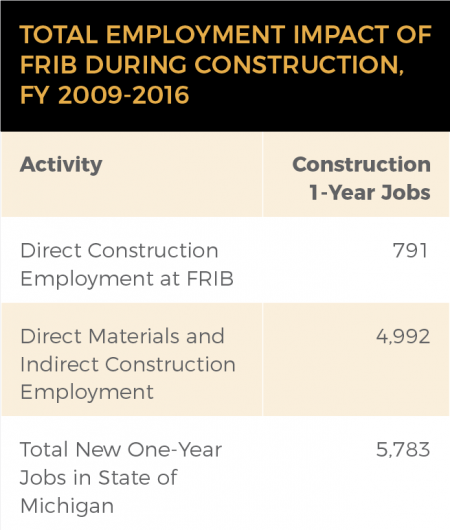
AEG translated the details of FRIB’s construction and operations into economic inputs and used IMPLAN’s software and data to calculate the potential economic benefits in terms of state and federal taxes, jobs, and employee earnings. As part of MSU’s initial project application, AEG carefully noted what materials and services could be sourced from in-state suppliers and what parts of the construction phases would have to rely on out-of-state sources. Whenever possible, the construction would rely on in-state resources to drive the local economy. Altogether, the economic impact would be significant.
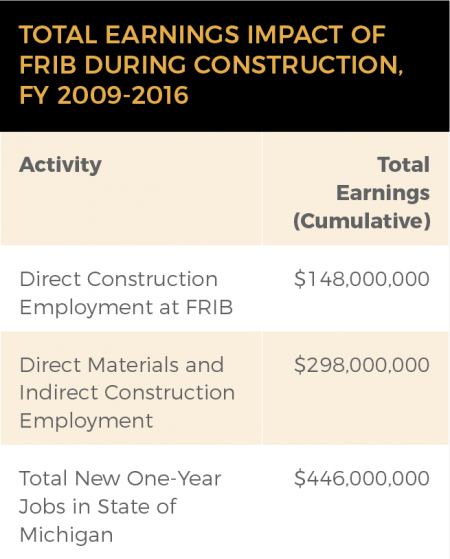
“Our analysis concluded that the FRIB project is a rare opportunity for the State of Michigan to lock in a very large stream of future earnings and anchor a high-tech center. We estimated that the total economic activity associated with the FRIB will exceed $1 billion over the initial decade. We also confirmed that new tax revenue the state would earn on construction and operation of the FRIB over a twenty year period is over $187 million” (AEG, December 2008).
AEG also estimated that the FRIB would increase tax revenue to the state of Michigan. During the eight year design and construction period, state tax revenue would increase by a total of $36.2 million. “This is a great day for science,” said MSU President Lou Anna K. Simon. “We are grateful to the Department of Energy’s commitment to address this critical priority for the nation’s physical sciences research infrastructure, and we are proud to have been selected as a partner. We are deeply dedicated to working with the Department of Energy’s Office of Science to develop an exceptional user facility serving the needs of national and international scientists. This is the first step on the journey.”